How American Tariffs Quietly Rewrote the Rules of Car Buying in Calgary
The sticker shock is real. Here's what's driving it — and how savvy Calgary buyers are responding.
There's a moment that's been playing out in dealership showrooms across Calgary lately. A buyer walks in, coffee in hand, ready to pull the trigger on a vehicle they've been researching for weeks. They know the model, they know the trim, they've even run the numbers on their phone the night before. Then the salesperson slides the quote across the desk. The number is wrong. Not by a little. By thousands. What's happening isn't a dealership trick. It isn't a supply chain glitch or a local quirk. It's the ripple effect of one of the most sweeping trade policy shifts Canada has seen in a generation — and if you're planning to buy a car in 2026, you need to understand it.
The Tariff Tsunami Nobody Saw Coming When the United States rolled out a 25% tariff on Canadian vehicle imports in early 2025, the headlines focused on factories and trade negotiations. What got lost in the noise was the downstream effect on ordinary Canadians — the people who just needed a reliable vehicle to get to work, drop the kids at school, or handle an Alberta winter. Here's the mechanics of it: Canada and the U.S. have been automotive neighbours for decades. Vehicles, parts, and components have crossed the border thousands of times during a single car's production cycle. A truck assembled in Ontario might have an engine block from Michigan, a transmission from Mexico, and electronics from a supplier in Kansas. The integrated nature of North American auto manufacturing was a feature, not a bug. The 25% tariff broke that logic. Suddenly, every vehicle that crossed the border carried a tax — and in the automotive industry, costs don't get absorbed. They get passed on.
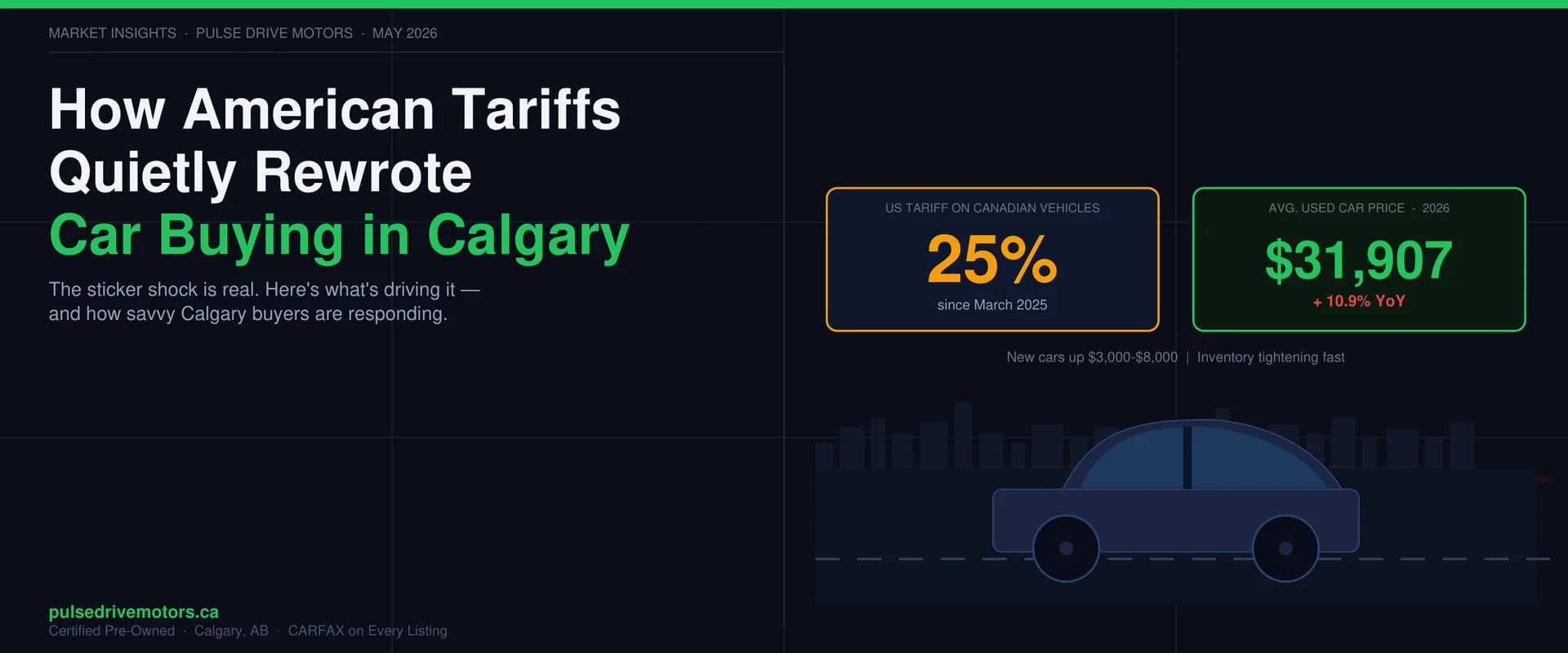
The Numbers That Should Be On Every Calgary Buyer's Radar Let's talk specifics, because this is where the rubber meets the road. The average price of a used vehicle in Canada hit $31,907 in early 2026 — a figure that would have seemed extraordinary just two years ago. More telling is the trajectory: used car prices are up roughly 10.9% year-over-year, a rate of increase that outpaces inflation and has fundamentally shifted what buyers in the $25,000–$35,000 range can expect to get. New vehicles tell an even more dramatic story. Manufacturers that source heavily from U.S. plants have been forced to recalibrate pricing. Canadian consumers are now routinely paying $3,000 to $8,000 more for domestically popular models than their pre-tariff equivalents. Pickup trucks — the backbone of Alberta's vehicle market — have taken some of the hardest hits, with certain configurations seeing price increases that put them beyond reach for buyers who had been loyally driving that same nameplate for years. The used car market, predictably, absorbed the overflow. When new becomes unaffordable, demand floods into used. When demand spikes in a market with constrained supply, prices follow. It's Economics 101 — but that doesn't make it sting any less when you're the one writing the cheque.
Why Calgary Feels This Differently Than the Rest of Canada Alberta's relationship with the automobile is different from Toronto or Vancouver. This isn't a city built around transit. It's a city built around distance — distance to job sites, to the mountains, to the acreages where a lot of Calgarians actually live. A vehicle here isn't a luxury or a lifestyle accessory. It's infrastructure. That means the demand curve doesn't flatten when prices rise. Calgary buyers don't have the option to take the subway instead. They adapt — they stretch their budget, they consider older models they wouldn't have looked at previously, or they hold onto vehicles longer than they'd planned. And this is where Calgary's market shows real character. The appetite for certified pre-owned trucks, SUVs, and AWD vehicles has surged. Buyers who once had their sights set on a brand-new F-150 are now very interested in a well-maintained 2021 or 2022 model. Buyers who were eyeing a 2024 RAV4 are looking hard at a 2020 or 2021 with low kilometres. The math works — for now. But that window is narrowing as pre-owned inventory tightens and prices there climb too.
The Inventory Squeeze: Why Good Used Cars Are Getting Harder to Find Here's something that doesn't get talked about enough: the tariff effect on used car availability is a lagging phenomenon. The cars that are "used" today were sold new two, three, or four years ago. Supply of quality pre-owned inventory depends heavily on the volume of new cars sold in previous years — and trade disruptions tend to compress new car sales, which means fewer vehicles will enter the used market down the road. In plain terms: the shortage you're feeling now may actually get worse before it gets better. This creates a counterintuitive urgency for buyers. The conventional wisdom used to be "wait and see" — hold off a few months and maybe prices will soften. In the current environment, that logic can work against you. Inventory is moving. The 2019–2022 model year sweet spot (low enough mileage, old enough to have absorbed depreciation, new enough to have modern safety features) is getting picked over fast.
What Smart Calgary Buyers Are Doing Right Now The buyers who are navigating this market successfully aren't panicking — but they're not sitting still either. Here's what we're seeing on the ground: They're expanding their make horizons. Brand loyalty is a luxury of a balanced market. In 2026, buyers who are open to Japanese, Korean, and European alternatives to their usual American brands are finding significantly better value. Vehicles from manufacturers with more Canadian or non-U.S. supply chains haven't absorbed the same tariff pressure. They're moving quickly on certified pre-owned. The combination of manufacturer backing, vehicle history, and remaining warranty coverage makes CPO inventory genuinely compelling right now. A well-certified used vehicle with 40,000 km can deliver near-new reliability at a price point that reflects the reality of 2023 — not 2026. They're not waiting for the "perfect" financing rate. Rate conditions will fluctuate. But if the vehicle you need is available now at a fair price, waiting for a rate drop that may not materialize while inventory shrinks around you is a gamble. The math on a half-point rate difference over 60 months rarely outweighs the cost of a price increase on the unit itself. They're getting a CARFAX before anything else. In a tight market, vehicles that might have been passed over in better times are moving. That makes vehicle history more important, not less. Know exactly what you're buying.
A Word About What Comes Next Trade policy is inherently unpredictable. There are ongoing negotiations, political pressures on both sides of the border, and economic incentives that could shift the tariff picture in either direction. Some analysts expect partial rollbacks; others see the current regime as the new baseline for years. What isn't debatable is the here and now. Calgary's used car market in spring 2026 is competitive, inventory is constrained, and prices are running hot. The buyers who wait for "normal" to return may be waiting a long time. The good news? There are still excellent vehicles available at prices that make sense — if you know where to look and move with purpose when you find the right fit.
Finding Value in a Seller's Market At Pulse Drive Motors, we've built our inventory specifically for Calgary buyers who are navigating exactly this environment. Every vehicle comes with a full CARFAX report, has been inspected by our team, and is priced to reflect the current market honestly — not inflated to capitalize on urgency. We're not here to pressure you. We're here to help you find the right vehicle at a price that works for your life. In a market this complicated, that matters more than ever. Browse our current inventory at pulsedrivemotors.ca — and if you have questions about timing, financing, or what to look for in today's market, we're always happy to talk.
Pulse Drive Motors | Calgary, AB | pulsedrivemotors.ca All pricing figures referenced reflect Canadian market data as of Q1–Q2 2026. Individual vehicle prices vary based on make, model, year, mileage, and condition.
Ready to find your next vehicle?
Browse our certified pre-owned inventory or book a test drive today.